
Resolve building disputes early
Mediation and Conciliation is a free and impartial service that helps home owners and licensees work through suitable residential building disputes.
A trained conciliator guides the discussion so both parties can understand the issues, explore practical options and work towards an agreed outcome.
The service is not an inspection, enforcement or legal process, and the conciliator does not decide who is right or wrong.
To use the service, you must meet the eligibility requirements and the QBCC must assess your dispute as suitable for mediation and conciliation. If the dispute is not resolved, your complaint can continue through the appropriate QBCC process.. The conciliator can discuss this with you.
Am I eligible for mediation and conciliation?
You may be eligible if all of the following apply:
- you are a QBCC licensee or property owner
- you are a party to a domestic building contract for a new home or major renovation
- work has started under the contract
- you have tried to resolve the dispute with the other party.
Meeting these eligibility requirements does not automatically mean your dispute is suitable for mediation and conciliation. The QBCC will also consider:
- the nature of the complaint
- whether there are significant safety risks
- the status of the contractor’s licence
- whether the dispute is appropriate for structured discussion and negotiation
- the status of the building work, including whether it has reached practical completion.
If your dispute is suitable, the QBCC may invite both parties to take part.
How the process works
Click on image to enlarge
-
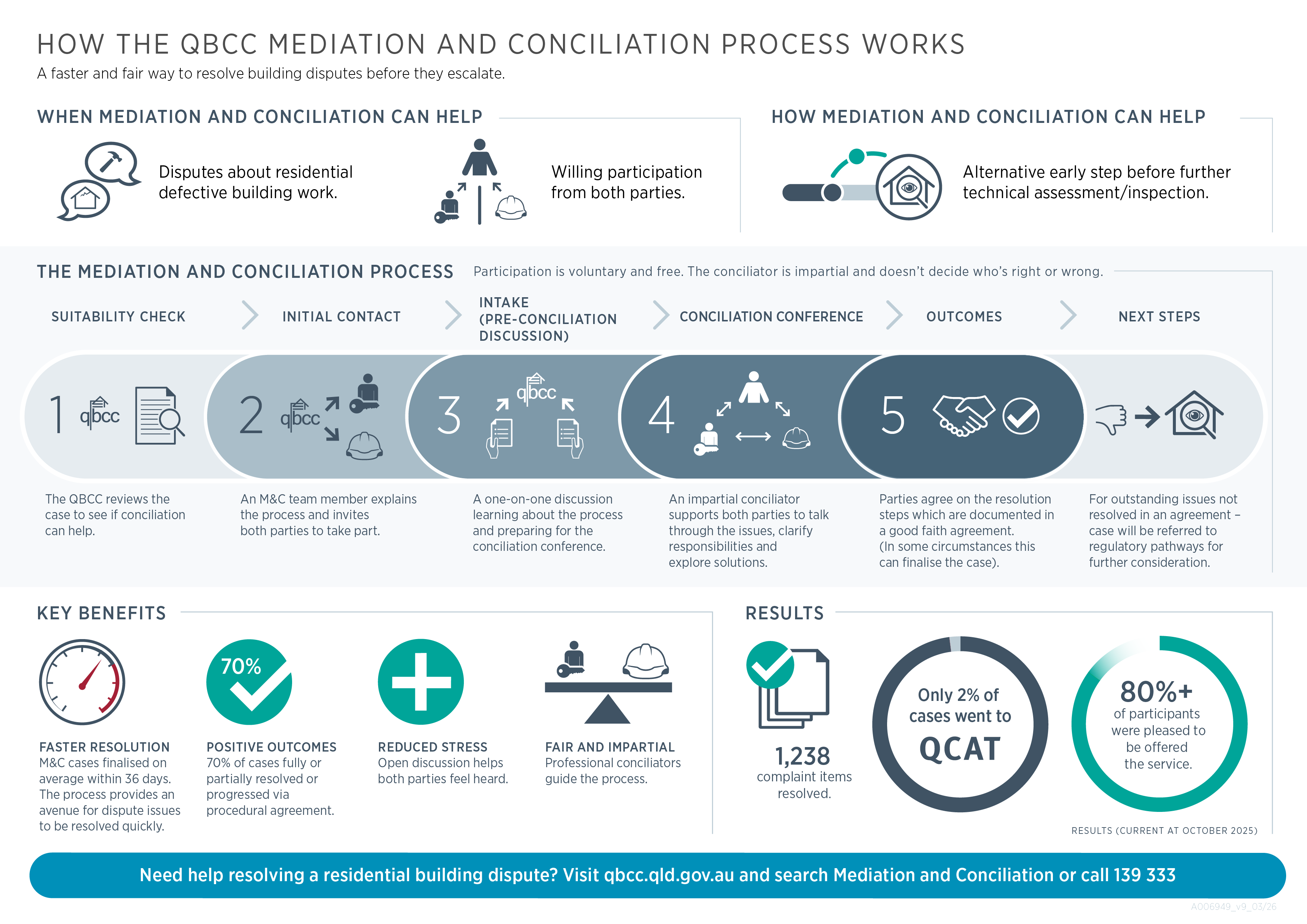
If a dispute arises during your residential building project, lodge a complaint through the complaints and disputes page. The QBCC will assess the complaint to decide whether mediation and conciliation may help.
-
If the dispute is suitable, the QBCC will contact both parties by phone or email, explain the process and invite them to take part.
-
Each party has a separate discussion with a QBCC officer to understand the process, clarify the key issues and prepare for the conciliation conference.
You may bring a support person or representative where appropriate. Before taking part, you must agree to participate in good faith and follow the Mediation and Conciliation terms and conditions/
-
An impartial conciliator guides a structured discussion by phone or virtual meeting. Both parties can explain their concerns, clarify responsibilities and explore practical solutions.
-
If an agreement is reached, the outcome is documented. The agreement may fully or partly resolve the dispute or set out the next steps.
If issues remain unresolved, the complaint will continue through the appropriate QBCC process and keep its place in the inspection queue.
Why use mediation and conciliation?
Using mediation and conciliation may help you:
- resolve the dispute earlier than through a formal process
- have a focused and respectful discussion supported by an impartial conciliator
- explore practical solutions that reflect your circumstances
- better understand each party’s responsibilities and the available next steps
- reduce stress and maintain a working relationship with the other party.
What results has the service achieved?
Recent service evaluation found:
- 70 per cent of matters were fully resolved, partially resolved or progressed through procedural agreement
- 40 per cent of matters were fully resolved
- only 2 per cent of conciliated matters progressed to QCAT
- over 80 per cent of participants reported they were pleased to be offered the service
Mediation and conciliation does not replace the QBCC’s complaint and regulatory processes.
If your dispute is not suitable, you choose not to participate where participation is voluntary, or the dispute is not resolved, your complaint will continue through the appropriate QBCC process.
Depending on the issue, this may include an inspection, investigation, compliance assessment or formal decision. The outcome may not be what either party expected, and the process may take longer than mediation and conciliation.
If mediation and conciliation is not suitable, the team can provide information about other options, including QCAT. The QBCC cannot provide legal advice.
Is participation compulsory?
Participation is generally voluntary.
In some circumstances, the QBCC may require parties to participate in mediation and conciliation. For example, the QBCC is currently trialling mandatory mediation and conciliation for some building dispute matters involving body corporate building work.
If participation is not required and a party chooses not to take part, the matter will continue through the QBCC’s standard regulatory process.
Does the conciliator make a decision?
No. The conciliator facilitates discussion but does not decide the outcome.
Are agreements legally binding?
Agreements record the actions both parties agree to take in good faith.
Mediation and conciliation does not determine legal rights or obligations. If issues remain unresolved, the matter may continue through the relevant regulatory pathway.
What if technical information is needed?
Where appropriate, technical information or guidance may be referred to or provided to support discussions.
Need more information?
The Mediation and Conciliation team can explain the service and what happens next.