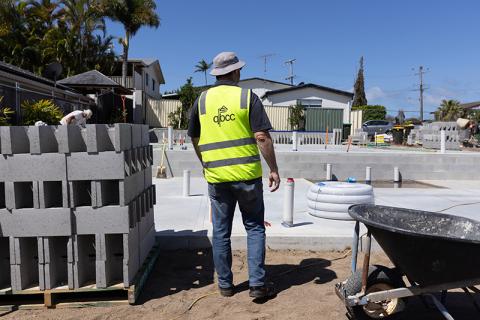
Queensland’s building and construction industry is facing a demographic shift that demands urgent attention.
The latest QBCC Industry Snapshot reveals that the average age across all licence classes (excluding fire protection) is now almost 49 years. In some categories, such as Builder – Open (54 years) and Joinery (53 years), the figures are even higher.
Meanwhile, the number of individuals under 30 comprise just 6 per cent of our 122,000+ licensees.
This is more than just a statistic- it highlights a growing imbalance between experienced professionals nearing retirement and the limited number of younger workers entering the trade-specific workforce.
Without strategic intervention, Queensland risks a skills vacuum that could stall progress on critical infrastructure projects and compromise the quality and safety of the built environment, especially in the middle of a housing shortage and as preparations for the 2032 Olympic and Paralympic Games start to ramp up.
Construction Skills Queensland (CSQ) Horizon 2032 Report
The CSQ Horizon 2032 Report paints a vivid picture of the decade ahead. Queensland’s construction pipeline is forecast to grow from $53 billion in 2024–25 to $77 billion by 2026–27, driven by population growth, the Brisbane 2032 Olympic and Paralympic Games, and the transition to net-zero energy.
However, this boom comes with a workforce challenge. The report projects a peak demand of 156,000 construction workers in 2026–27, with an average shortfall of 18,200 workers annually over the next eight years.
Key trades such as carpentry, plumbing, electrical and concreting are expected to lead this demand.
Succession planning
What this report also reveals is an area of contention – one that raises the question about succession planning no longer being a luxury, but a necessity to support the building and construction industry across Queensland.
As seasoned tradespeople retire, the risk of losing decades of expertise grows, but by actively looking to the future, succession planning ensures:
- continuity of business operations
- preservation of trade knowledge
- maintenance of safety and compliance standards
- timely delivery of infrastructure projects.
Without a steady pipeline of younger workers, Queensland’s ability to meet its infrastructure commitments could all be compromised if solutions aren’t found.
What the Industry Snapshot tells us
The QBCC Industry Snapshot provides a data-informed overview of licensing trends, age demographics and workforce maturity. It’s a valuable tool for identifying succession risks and planning workforce development strategies.
The snapshot also highlights:
- regional disparities in workforce age
- licence classes with critical ageing trends
- opportunities for targeted workforce renewal.
What can be done
To address the ageing workforce and skills shortage, a multi-pronged strategy is needed:
1. Reform occupational licensing and improve labour mobility
The Queensland Productivity Commission (QPC) supports reforms such as Automatic Mutual Recognition, streamlined licensing processes and recognition of prior learning.
These changes aim to reduce barriers to workforce entry and improve workforce flexibility.
2. Align vocational education with industry needs
Recent investments including a $115 million funding package under the National Skills Agreement aim to improve completion rates, expand access to foundation skills, and support training in emerging industries and trades.
However, studies show a misalignment between vocational education and training (VET) enrolments and actual labour market needs, with over-enrolment in low-demand areas like fitness-related careers and under-enrolment in critical trades needed in the building and construction sector.
3. Promote trades as professional, purpose-driven careers
Trades are professional career pathways that people should be proud to embark on and campaigns looking at recruitment, study and retention should highlight this as well as the professionalism and entrepreneurial opportunities that exist in this space.
This shift in messaging can help attract younger talent and diversify the workforce.
4. Support mature workers and lifelong learning
Older workers remain a valuable asset. Strategies such as blended roles, flexible shifts, and targeted health and safety support can extend their participation and reduce injury risks. This cohort can also share their knowledge and experience and teach the tricks of the trade to the next generation coming through.
5. Strengthen industry-government collaboration
One of the most effective ways to future-proof Queensland’s building and construction workforce is through stronger collaboration between industry and government.
This is where programs like Industry Skills and Jobs Advisors (ISJA) and Regional Jobs Committees play a pivotal role.
What does this collaboration look like?
These programs act as a bridge between employers, training providers and government decision-makers, ensuring that workforce planning is grounded in real-world industry needs. They gather evidence-based insights into:
- skills gaps and emerging jobs
- regional workforce challenges
- training quality and relevance
- employment trends and future demand.
By doing so, they help shape VET programs that are aligned with actual labour market needs, not just theoretical projections.
Why is this needed?
Without coordinated planning, training investments risk being misdirected and lead to an oversupply of graduates in fields and industries that aren’t facing a skills shortage like the building and construction sector.
Industry-government collaboration helps:
- target training investments where they’re most needed (for example, carpentry, plumbing, electrical)
- reduce duplication and inefficiency in workforce programs
- support regional communities with tailored skilling solutions
- ensure reforms are timely and responsive, especially in licensing and labour mobility.
Examples of impact
The ISJA program, expanded in 2025 with a $17 million investment, now supports 14 key industry sectors including construction. Advisors provide strategic advice to government on training priorities, licensing reform, and workforce development.
Regional Jobs Committees operate in 12 locations across Queensland, developing localised strategies to address workforce shortages and connect stakeholders with funding, training, and employment pathways.
Together, these initiatives help ensure Queensland’s workforce strategy is proactive, helping the construction industry build the talent pipeline it needs for the decade ahead.
Looking ahead
The ageing of Queensland’s building workforce is a challenge, but it also presents an opportunity that can future-proof the industry and turn Queensland into the building capital of Australia. By leveraging data from the Industry Snapshot, embracing reform, and investing in strategic workforce development, Queensland can build a resilient, future-ready construction sector.
We encourage all stakeholders, builders, educators, policymakers, and regulators to treat succession planning as a strategic priority. The time to act is now.
Explore the full QBCC Industry Snapshot for more insights.