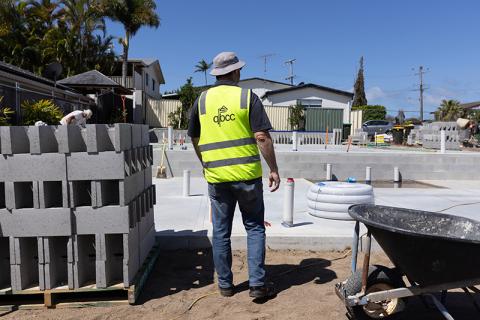
Although these elements of a build may seem straightforward at face value, small oversights in design, preparation or installation can lead to cracking, ponding water and moisture-related problems that require costly rectification. Many of these issues are preventable when the core steps are followed.
Understanding the issue
The QBCC Standards and Tolerances Guide is the first reference point when assessing whether a defect exists, offering Queensland’s accepted benchmarks for work and performance.
Concrete paths are susceptible to movement, shrinkage and environmental conditions. These problems arise when paths are placed too close to walls without movement joints, and when surface falls are incorrect or are not designed for their intended use.
In some situations, water is directed back toward the home or neighbouring properties, which breaches the National Construction Code’s moisture and surface water management requirements.
Smart prevention over a reactive cure: What’s happening on site
Many of the issues we see are rooted in the preparation phase:
- Soft or uneven foundations reduce path performance. The QBCC emphasises uniform, well-compacted material and removing all soft spots before concrete is placed. Visit our article on Waterproofing done right: what you need to know in 2025 for a guide to getting this right.
- Reinforcement often fails when mesh drops to the bottom of the slab. Correct cover and support are essential to control cracking.
- Missing isolation joints at walls or other rigid structures allows movement to transfer into the concrete. Australian Standard – Pavements section AS 3727.1 outlines suitable jointing methods for residential paths.
- Hot, windy weather speeds up evaporation, increasing the risk of early‑age surface cracking caused by rapid drying.
Checking forecasts and timing pours accordingly may help prevent minor cracking.
Getting it right
Good outcomes start well before concrete is poured. Design, planning and site checks have the biggest influence on performance.
Some essentials to keep in mind include:
- keeping paths suitable for light-use residential applications and designed in line with Australian Standard – Pavements section AS 3727.1
- maintaining clearances from building damp-proof courses and ensuring concrete pathways do not bridge moisture or termite barriers
- confirming that paths and driveways fall away from the home and towards approved drainage or lawful discharge points.
During construction, set out is critical. Even small variations in surface levels of concrete can cause water to pool at slab edges, and enter weep holes or other vulnerable points. Joint layout, reinforcement support and curing should be treated as core quality controls, not optional extras, as these aspects may affect long-term performance of the concrete driveway or path.
Cleaning adjoining surfaces immediately after pouring also prevents staining and reduces the likelihood of disputes.
If things go wrong
Early communication with the home owner often resolves concerns before they escalate. The QBCC’s Mediation and Conciliation pathway supports this by guiding constructive conversations between parties and helping them agree on practical next steps. This early‑resolution approach keeps projects on track and often prevents issues from progressing to formal enforcement. Maintaining clear records of specifications or variations, along with photos of preparation and reinforcement placement, also helps clarify expectations and demonstrate compliance if questions arise later.
If you’ve been issued a Direction to Rectify by the QBCC, it’s important to undertake the required action. Doing so helps protect your licence history and reduces the risk of fines or other enforcement action.
Quick checks before you pour
A check list acts as a simple reminder of the things that need to get done on the job – from start to finish. We suggest including some preventative checks to ensure that:
- foundation is uniform and well compacted
- formwork is rigid to support designed concrete depth and placement
- vapour membrane barriers are placed over foundation
- height pins and finished formwork surfaces are checked prior to pour
- concrete strength suitability (MPa) for proposed use is selected
- mesh is supported (e.g. bar chairs) with the correct cover
- isolation and control joints are set out and installed correctly
- falls direct water away from the home, as per the NCC
- weather conditions are suitable for concrete placement and curing.
A well-planned approach at this stage sets the tone for the entire job. Ensure the groundwork, design and drainage are confirmed with the client before the concrete arrives, and relevant parties are kept informed throughout the project of any amendments to the design or additional costs that may occur.
Communication is imperative as disputes will become far less likely and conversations with home owners will stay positive. Investing a few extra minutes in these checks supports durable footpaths, smoother inspections and stronger project outcomes overall.